PRACTICE · MEDICAL AI
Medical AI: Building a Verifiable Decision-Support Platform
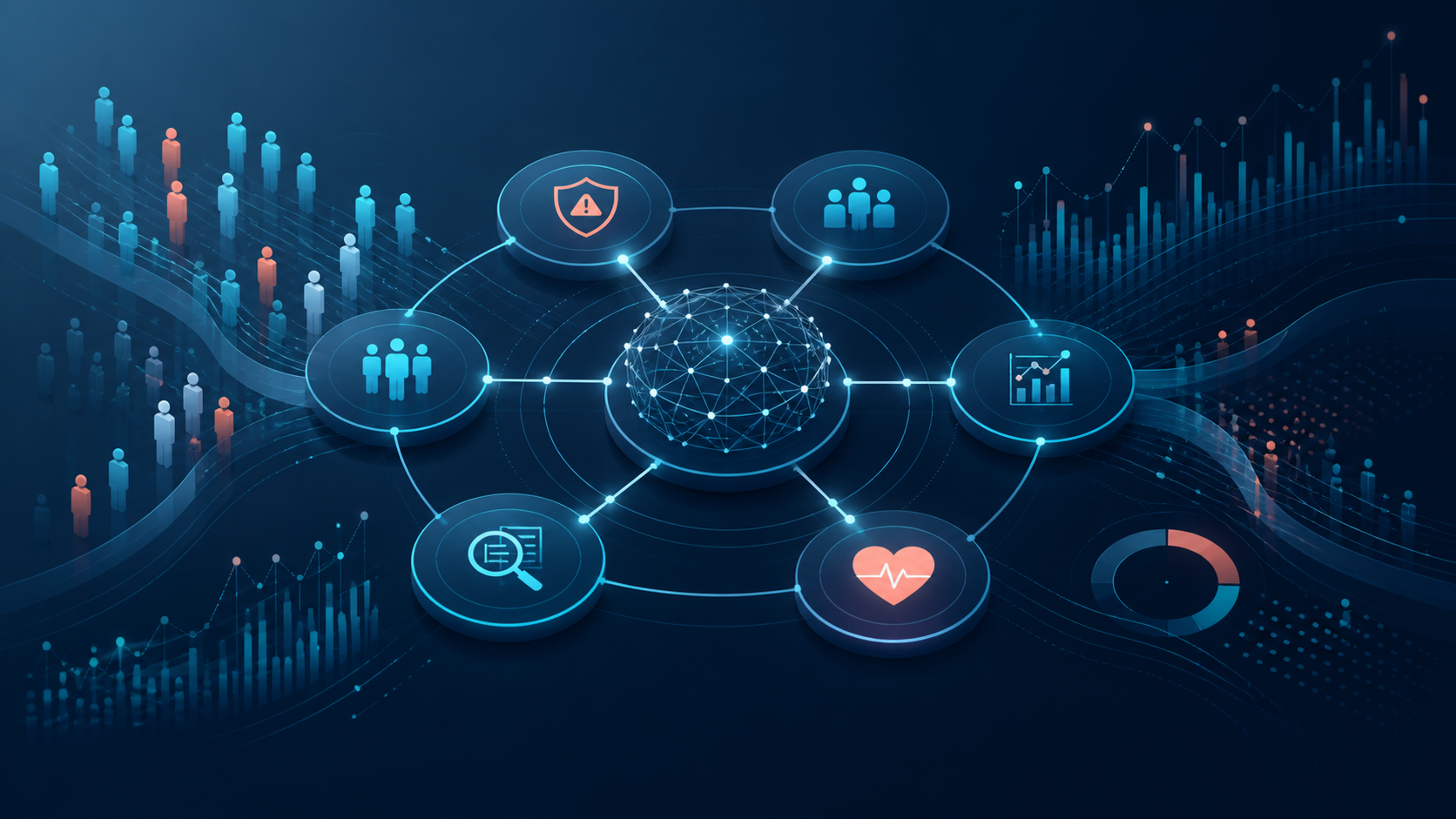
We are working on a system that connects risk assessment, prevention, sickness absence, and health-program outcomes into one manageable cycle. AI is not being used as an “autonomous physician.” It helps restore knowledge, retrieve evidence, and prepare decisions that professionals can verify.
Not Another Medical Chatbot
The project goes beyond questionnaires or document storage. It is designed to support the health and productivity of large organized populations, such as a company workforce.
The target cycle is straightforward: assess the current state, define goals, create an action plan, deliver preventive interventions, measure change, and adjust the program. Individuals receive a clearer support pathway. Specialists gain planning and monitoring tools. Management receives aggregated analytics about risk, health trends, absence, and program outcomes.
The First Challenge Is Restoring the Knowledge System
The domain model evolved over many years. Knowledge is distributed across documents, tables, classifications, presentations, and application code. The same concept may have multiple versions, while a formula in an old presentation may differ from the calculation implemented in software.
We therefore do not load everything into a model and ask it to “figure it out.” We build a verifiable chain: source → structured claim → function → calculation → report → responsible role. Contradictions remain visible until a qualified expert resolves them.
How AI Helps Us Today
- Inventory. AI helps classify large collections and locate related materials.
- Provenance. Every material conclusion retains a source coordinate, not merely a polished summary.
- Function mapping. We connect data to calculations, interfaces, reports, and roles.
- Conflict control. Duplicates, competing versions, and missing fields enter a review queue.
- Corpus preparation. Documents become a structured retrieval layer without replacing the originals.
- Tests and specifications. AI accelerates preparation, while deterministic artifacts verify the result.
RAG with Citations and the Right to Abstain
The next layer is RAG: retrieving relevant evidence before generating an answer. In a medical setting, persuasive wording is not enough. An answer must identify its source and edition. When evidence is missing or conflicting, the safe behavior is to abstain explicitly.
This extends our work on source grounding and RAG citation integrity.
What Must Remain Deterministic
Critical formulas, contraindication rules, permissions, and state transitions must not depend on free-form generation. A model may explain a calculation, but verified code performs it. A model may retrieve evidence, but professionals review medical decisions.
This is why medical AI is an engineering and governance problem, not only a model-selection problem. Teams must define data boundaries, quality criteria, failure states, and professional oversight.
Our Plan
- Complete the inventory of sources, rights, versions, and provenance.
- Build a canonical medical knowledge base and relationship graph.
- Separate verifiable formulas and rules from the generative layer.
- Develop RAG with citations, abstention, and freshness controls.
- Create a professional evaluation set and clinician-review workflow.
- Adapt models only where evaluation reveals a measurable RAG limitation.
- Add jurisdictions one at a time, with local guidance, terminology, and data requirements.
Multilingual Does Not Mean Translated
Entering another jurisdiction requires local clinical guidance, classifications, privacy rules, and validation by qualified local professionals. Searches such as “AI medical devices European Union” also reflect the regulatory questions that a cross-border product must address. A rule cannot be transferred automatically merely because a model can translate its wording.
The Responsibility Boundary
The project is being developed as decision support and health-program management, not autonomous diagnosis. Real medical records do not become training data automatically. They require a separate lawful basis, minimization, de-identification, and access controls.
For us, the value of AI is its ability to turn a complex body of knowledge into a transparent, verifiable, and continuously improving system—while leaving the final decision to evidence and qualified professionals.